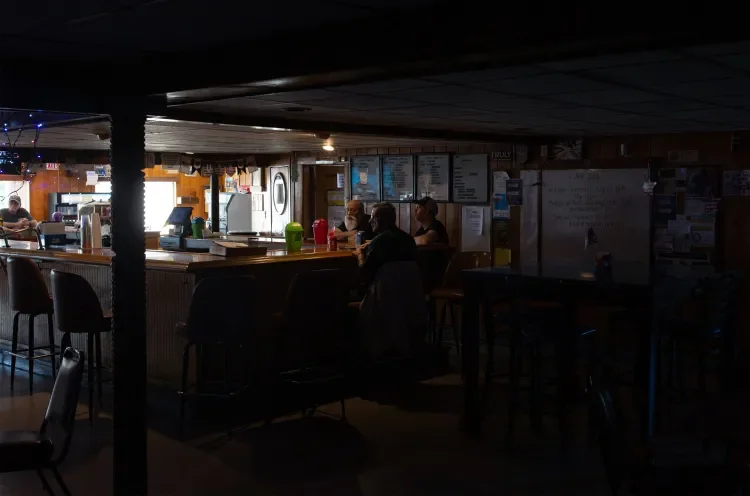
One of the last places for veterans in Portland is for sale. Regulars say leaving would be painful.
AmVets Post 25 has been in the same Washington Avenue building since 1953, but now it’s on the market. Veterans say letting go of the place will be tough, even if the post opens in a new spot.
Portland Press Herald | July 2025
By Grace Benninghofff
Click here to read the article on the Press Herald’s website.
On a July afternoon in Portland, the “open” flag hangs limp in the hot air over AmVets Post 25.
Inside 186 Washington Ave., the shades are drawn, save for a picture window overlooking Back Cove. A fan whirs in the corner, keeping the place cool.
Rebecca Corkum, 35, is mixing up a vodka-cranberry as Matt Keating, 63, slides a couple of bucks across the bar. His rescue dog, Ms. Buddy, is stretched out at his feet.
A few stools over, Dick Paiement, 84, is sipping a Bud Light.
“My wife, I can’t understand what she says half the time,” Paiement says, leaning over the bar to talk to Keating.
“Oh, yeah, like if somebody is talking over there and over here at the same time,” Keating replies, pointing in two different directions, “your head rings.”
Paiement nods. “Yeah, that’s from listening to the bang, bang, bang, being in the tank in Vietnam.”
This is how the men spend many afternoons: together, in the cool dark of the post that’s been a place for veterans to congregate in Portland for more than 70 years. But soon, the post may close down — or, at the very least, move to a new location.
About six months ago, Post 25 members voted to sell the building after they found out they would be losing access to the large parking lot across the street at the Northern Burner building, which was sold last year and is slated to be turned into apartments.
For decades, that lot has enabled veterans in the area to come to the post. Many of them are disabled and can’t walk far or easily navigate public transportation.
But without parking, members say, not enough regulars will be able to come for the place to stay open.
“They’re pretty much closing us down,” said Keating, clearing his throat and wiping at his eyes. “I mean, I understand progress is progress. But there’s lot of love that’s gone into this place.”
A LIFETIME
The walls of Post 25 are crowded with memories.
There are countless obituaries for local veterans. A wilted yellow ribbon is tied around a vase near the front door — a memorial to prisoners of war. A child’s drawing is displayed near the bar; in purple and blue and red marker, it reads “thank you veterans.” There are old trophies, a Desert Storm flag, Post 25’s articles of incorporation, old newspaper clippings — the kind of things anyone might collect over a lifetime.
And the post has been open for about a lifetime. Post 25 has been at this location since 1953. The building, which went up in 1930, is named after Charles Loring Jr., a Medal of Honor recipient who served as a fighter pilot in World War II and the Korean War.
In the 72 years that the post has been on Washington Avenue, the neighborhood has changed — especially in recent years. What was once an industrial street defined by the blocklong John. J. Nissen Baking building and the scent of sewage wafting in when the wind hit Munjoy Hill right has transformed into one of the city’s hippest neighborhoods.
A pottery studio, a kombucha taproom, a Scandinavian bathhouse and a selection of bustling restaurants now dot the corridor. Decades ago, the post might not have needed an adjacent parking lot so desperately, but now it’s hard to find a spot along Washington Avenue even on a weekday afternoon, let alone a Friday or Saturday night.
AmVets itself — short for American Veterans — is one of the oldest veteran service organizations in the country. It has seven posts across Maine and more than 250,000 members nationally.
Keating has been a member for 40 years and views the Washington Avenue post as a second home. One winter, when he couldn’t find a place to live, he and Ms. Buddy slept outside the post in his car. He felt safer there than anywhere else.
He says the place has given him something that feels like family. It’s true for most of the regulars there.
“This used to be what you did with your dads, you know?” Keating said. “You brought them to these places so they could hang out and just have someone to talk to.”
The AmVets building is assessed by the city at $782,500 but has been listed for $1.3 million by The Boulos Company. A board member who asked not to be named said the post hopes to find a new location with ample parking and won’t sell until such a spot is found. John Finegan, an associate broker with The Boulos Company, told the Press Herald earlier this month that the building has been listed for about six months.
Post 25 is open seven days a week as a bar, but over the years, it has hosted holiday parties, fundraisers, baseball leagues and cornhole tournaments. There’s a pool table, a card table downstairs and dart boards on the wall.
Richard Egeland, 58, has been a member all his life. He’s not a veteran but was eligible for membership because his dad served in Vietnam. He played on the Post 25 Little League team as a kid and had birthday parties in the yard out back.
“I just come in and cherish the moment until D-Day hits and we’re a thing of the past,” Egeland said.
Egeland, who now lives in Gorham with his father, knows he could go to the local American Legion if Post 25 closes.
But this post, one of the last holdouts of an old Portland, is where he grew up.
“This is where my loyalty lies,” he said.
‘WE MAKE SURE HE’S OK’
At about 4 p.m., someone new comes in the door. He’s younger than the other guys.
“Hey, Roy,” Corkum says, filling a glass with Pepsi and sliding it across the bar to him before he’s even sat down. He pulls up a seat between Paiement and Keating.
Roy Brooks, 44, has been coming to Post 25 since he was a kid. His father and uncle were veterans, but both men have now died. Brooks has a disability. His aunt drops him off every day at the post for a couple of hours.
“He can come in here anytime, and nobody gives him any crap,” said Keating. “He likes his soda and likes to play tickets a little bit. We make sure he’s OK.”
Corkum has several regulars like Brooks. Not all have disabilities, but there are plenty of guys who come in and don’t talk much. Some have traumatic brain injuries. She said those are the guys she worries about the most if the post has to change locations. Most come in because they live nearby or because the location holds memories for them.
“It’ll be different,” she said of the potential move. “Just because we’re so used to this place, the memories in here. Like we could point over in that corner and say, ‘That happened there,’ ‘that happened here.’ So yeah, it’s gonna be hard.”
In some ways, Corkum says, she, too, feels like she grew up at the post. She has memories of playing cornhole out back in her early 20s, of Christmas parties with her old boyfriend, who she joined the organization with but has since died.
“It’s just been awesome, getting to know the people that come in. … And of course, I have all my favorite regulars. Right, Dicky?” she says, grinning across the bar at Paiement.
“What?” he says.
Everybody laughs, including Louis Napoleon, who’s sitting down the bar alone. The breathy chuckle is the first thing that’s come out of his mouth in hours.
Napoleon, 74, was a prisoner of war who was injured while in the service. Nobody talks about the specifics. The other guys say he seldom talks, and when he does speak, his voice is soft, sometimes stilted.
“It’s a special club,” Napoleon said, looking out the picture window at the shimmering blue of Back Cove. He’s been coming here for years, but nobody can remember exactly how long.
If the post moves, he probably won’t go to the new location. He doesn’t drive and lives just around the corner.
It’s here that he feels comfortable.
“It’s sad, but what are you gonna do?” Napoleon said. “What can you do?”